
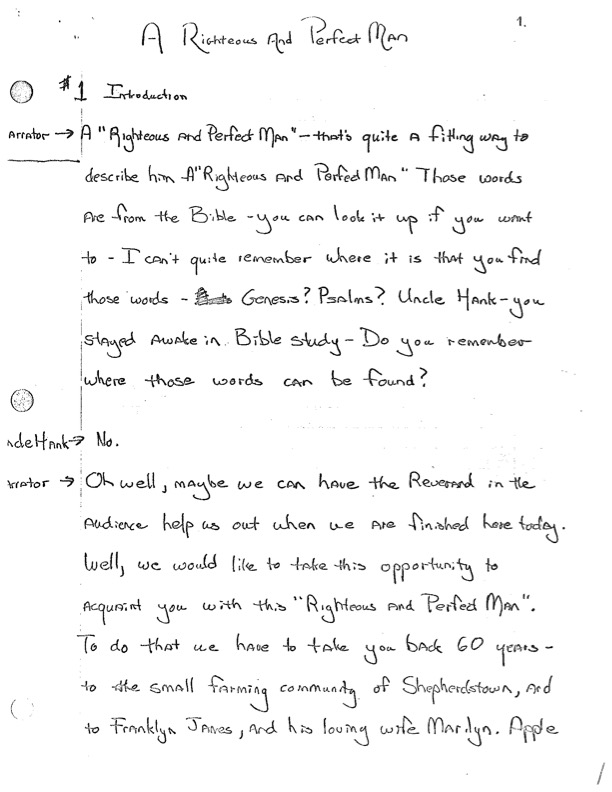
One of the first musicals I created, A Righteous and Perfect Man (ARAPM) is something of a parable, and definitely not your traditional middle school musical. It was conceived around Christmas 1984 and is a result of watching It’s A Wonderful Life. The plot of ARAPM revolves around Stuarte James (based on the actor Jimmy Stewart.) I wanted to present an alternative to the happy ending of It’s A Wonderful Life and other similar stories, such as the story of Job in the Old Testament.
The musical is staged as a meeting of Stuarte’s uncles and aunts, discussing Stuarte’s life in retrospect. The first song (Stuarte) celebrates Stuarte’s birth to his parents Franklin and Marilyn. Stuarte is encouraged to join the family banking business but chooses to sell produce instead (Stuarte Starts a Business) . The third song captures Stuarte’s joy at having found a wife, Caroline (Stuarte Takes a Wife). Next, a lovely waltz to celebrate the birth of his son, Cage (Cage is Born). All is right in the world. Stuarte is prospering and the cast of uncles and aunts are most impressed. Then things take a turn for the worse.
It would take a long, long time to dig into why a 31 year-old music teacher would write a middle school musical that turns so, so negative. If there has been one major thing that has come out of my investigations into my past musicals, it is that they represent aspects of myself that I was incapable of recognizing at the time they were created.
Stuarte’s son Cage hates produce. So, Cage, now in charge of the business, plans to sell out to a couple of shady characters, Newark Neil and Secaucus Syd (Cage and Neil.) We never find out what happened, but, here we go, Cage is gone. His death is devastating for Stuarte and Caroline (Cage is Gone.) Unfortunately, Caroline dies soon after, no reason given (Caroline Dies.) Stuarte is left with nothing but his head in his hands.
The cast of uncles and aunts demand a happy ending. Stuarte never did anything wrong. Why was he being punished? Or, perhaps he did do something wrong, but, we haven’t done anything wrong, have we?
Enjoy. Comments are always welcome.
THE SONGS
Stuarte: All these songs are short. The entire show is only 30 minutes. The opening song is tightly written, with a super short chorus. Originally, the chorus had a couple of 5/4 measures, but the cast found it too difficult.
Stuarte’s name, and those of his parents, come from “It’s A Wonderful Life.” Don’t get me wrong, I love the movie, but have always had a problem with the ending. Even as a kid I realized that life didn’t work that way. The story of Job in the Old Testament had a similar effect on me.
Stuarte Starts a Business: At the time I wrote ARAPM, I was a meat eater. Not many years after I gave up meat for Lent, and I never went back. By my estimation, it is now over 35 years. I think it is wonderful that I was including a vegetarian spin in my very first musical.
Stuarte Takes a Wife: Originally in 5/4 time, I re-did the song as a jazz waltz in order to have the cast feel more comfortable singing it. The chord pattern of a major I chord to a minor V chord is one I used throughout my composing life. It has a way of softening the exuberance of the event.
Cage is Born: This is probably the most autobiographical song in the musical. At the time of the production, I had two young boys who were in day care. This is how I felt about each of their births. This song is also a waltz, but faster than the previous one, and definitely more harmonically complex.
Cage and Neil: Wow, I wrote a 4:20 story song, that has no chorus! The opening bass line is what sets the whole thing off. Later on there are these Elton John style chords over an alternative bass. The whole thing captures the mood I was looking for.
As far as the references to two bad guys from New Jersey, I think that was a result of the 2 years I spent in Bayside, NY. As a young man from the DC area, New York was a mess, but New Jersey was just plain scary.
Cage is Gone: Why, oh why, did I have to write these last 2 songs? I wonder what the 6th graders were thinking (not to mention their parents.) They are very pretty songs, and in some ways, very touching, but they had no place in a 6th grade production.
The shift from a minor verse to a major chorus is one of my favorite devices for conveying mixed emotions. Cage dies, and there is never any explanation.
Carolyne Dies: And then the “pile-on”. Stuarte is a broken man. There is no Hollywood ending. There is no Biblical ending. What we are left with is a cast that only has questions and a script that provides no answers.
The song starts in a desolate minor key, and unlike the other songs, never moves to major.
 Sean Breen